
As I type, England
appear to have set themselves up for a consolatory win in their final ODI
against India this winter, a series they have already lost 3-1. If they make it
3-2, this will at least show progress for a team whose last three tours to India have yielded results of 5-0,
5-0 and 5-1. In England’s defence they are playing the world’s top
ranked ODI team, in their home conditions, and supremely motivated by the hammering
their Test match counterparts and alter egos took at the end of last year.
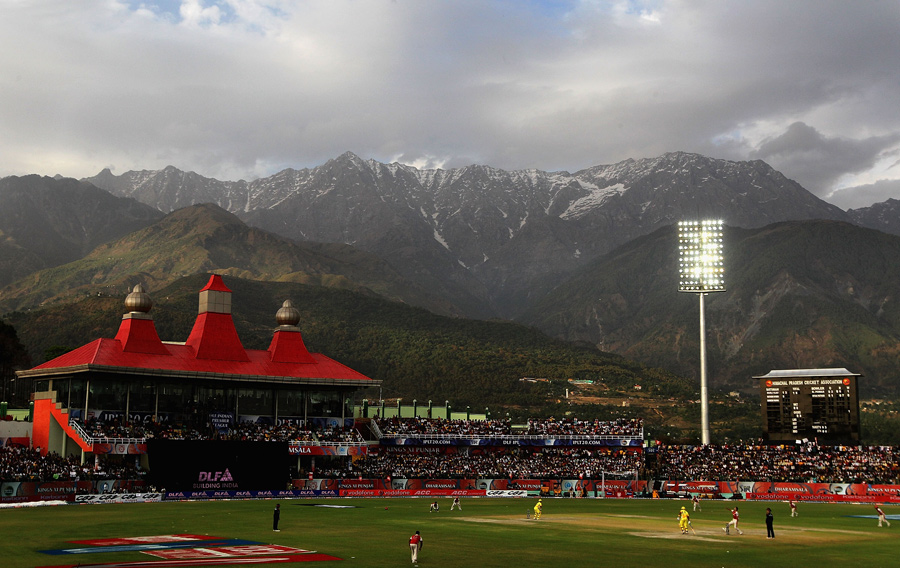
The action takes place
at the astonishing Himachal Pradesh Cricket Association
Stadium in Dharamsala, tucked in the unexpected spur of India that rises
between the Stans to the west and the Himalayas to the east, with China’s
swelling bulk beyond. If there’s a venue where cricket’s honoured dead gather
to reopen old wounds, rewrite history and revisit that oldest of cricketing
questions, ‘who really bowled fastest?’, Himachal Pradesh is surely it.
But enough of the scenery. While
the scoreline may end up reasonably close, England haven’t truly turned up to this
series since they stepped from the field at Rajkot, victorious by nine runs in
the opening encounter. Indian wins by 127 runs, seven wickets and five wickets
in the following three matches tell a one-sided story, which may have a
significant impact on the futures of several England players.
In the minus column, Jade Dernbach and
Craig Kieswetter have tested fans’ patience with a series of disappointing
performances with ball and bat respectively.
The jury has been out on Dernbach for a
while and, having been dropped from the ODI squad the forthcoming tour to New
Zealand, he appears to have run out of chances for now. It’s easy to see why England have
persisted with him. His repertoire of slower balls, often expertly delivered,
is balanced by genuine pace and he doesn’t seem phased by the big occasion.
Returns of 4-45 against Pakistan and 3-44 against South Africa last year show
what he’s capable of. But there have been many more hauls of no, one or two
wickets, at a cost of 50, 60 or 70 runs, leading to an average of nearly 39 and
an economy rate above six.
Dernbach also has the misfortune to be outlandishly
tattooed, flashily earinged, absurdly haircutted and OSAO*. Remind you of
anyone? While he’s baffling batsmen with slower balls conjured from behind his
sleighting hand, or pinning them with a quicker one, this is all forgivable.
But has no-one told him that with English fans, as soon as his performances
dip, all of this will be weighed in evidence against him? He's clearly been
spending too little time in the nets and too much in the cosmetic parlours and
salons of south London, or gazing into the windows of Hatten Garden’s diamond
merchants. Pack him back to Jo’burg where he belongs!
Living near the Oval I’ve seen a fair bit
of Dernbach in his day job over the last few years, and I wish him well. I
think he’s certainly got more to offer England, but there’s fierce competition
for fast bowling places at present and for now he’ll have to wait for the likes
of Hampshire and Durham to test his one-day skills, while others take the fight
to New Zealand and Australia over the next twelve months.
Kieswetter, like Dernbach, has been dropped
from the side for the back end of this tour, replaced by his Somerset teammate
(and wicket-keeping understudy) Jos Buttler. Buttler is not OSAO, despite his
name ringing alarm bells for the jingoists. It sounds unusual at first, but you
could also imagine him the hero of a Thomas Hardy novel, even if he’s Jos the
Obscure no longer.
Kieswetter is left out of the tour squad to
New Zealand, with Buttler and Bairstow the hard-biffing keeper-batsmen in his
place. As is de rigeur for Somerset batsmen, Kieswetter has an attitude to risk
and reward that only has eyes for the latter. We are often told he is favoured
by England for his six-hitting abilities, and then in the next breath that
however good he may be at finding the boundary, he allows too many dot balls,
too much pressure, in between times. So much for the clichés; more pertinently
he just hasn’t been contributing.
Kieswetter’s absence gives me mixed
feelings. I think Bairstow and Buttler will both be better bets in the short
and long term, and Buttler’s extraordinary work as Somerset’s short-form
‘finisher’ will surely bear fruit at the highest level. But Kieswetter is an
exciting cricketer and in possession of one of the most thrilling shots in
modern cricket: the charging lofted drive over mid-on that ends with the
batsman almost completely vertical, on tip-toe, with arms stretched above his
head, bat raised high in salute to the ball as it soars to the boundary. The shot
looks almost as good even when he’s stumped having missed it by a yard.
I am less optimistic about Kieswetter’s
future chances with England than Dernbach’s. The irresistible rise of Joe Root
this winter has secured one ODI batting spot already, with Jonathan Trott
likely to take another on his return. While Buttler has yet to prove himself at this level,
he’ll surely be given a run in the team and between him and Jonny Bairstow,
there’s class and competition enough. Cook, Bell, Pietersen and Morgan should be kept out of the side only by injury and ‘rotation’ now, so it’s
hard to see a way back. But England’s loss is Somerset’s gain, and I look
forward to seeing him in action as the county season gets underway.
For now though, England have the result they want on the back of a century from Ian Bell, his second good score in
the series bringing England’s second win.
Next time: a look at some of the winners
from this tour, including Kent’s new skipper James Tredwell. Amongst other
things, Tredders has been doing valuable work in keeping up the bald quotient
in the side, which had been receding since the retirement of Andrew Strauss.
* Of South African origin

No comments:
Post a Comment