Tuesday, 29 January 2013

An honest man’s the noblest work of God


Lawrence Booth, in his enjoyable Cricket, Lovely Cricket? (one of several light works about the game I have re-read whilst, er, resting from Will Self’s put-down-able page-closer Umbrella – one likes to keep fine books as well as fine cricketers on ‘rotation’) dedicates one chapter to the language of cricket. A pleasant paragraph is spent wallowing in commentators’ clichés such as Flintoff as ‘England’s Talisman’, and all leg-side shots played by subcontinental batsmen as ‘wristy’.

Clichés can be maddening to the cricket viewer, particularly in these times of stable team selection, where during a long Test series one can feel trapped in a nightmarish cycle of the same phrases about the same players in the same order all summer and winter long. Matt Prior has for years now been eternally ‘selfless’ and ‘surely now the world’s best wicket-keeper batsman’. Alastair Cook still doesn’t sweat much, apparently and is, would you believe it, in an excellent run of form.

Well thank goodness for short form cricket, which at least brings a change of cast that forces the see-speakers to think on their feet for a while.

One of the relative newbies to the international scene this winter was James Tredwell, Kent’s 30-year-old off-spinner, who first came to prominence beyond the county circuit when making his debut for England against Bangladesh in 2010. Tredders remains very much Graeme Swann’s understudy, and looks a long way from the Test team since the renaissance of Monty Panesar. But he’s been used increasingly in ODIs over the past couple of years and has an impressive record.

Without getting too bogged down in statistics, it’s worth considering that, having played only the world’s best ODI teams since his wicketless debut in Dhaka, Tredwell has 22 wickets in 14 matches at an average of 24.4 and economy of 4.66. This includes appearances in the last world cup and a significant role in the drawn series against South Africa last summer.

So why then was this strong performer consistently greeted by such a drab parade of lacklustre praise. Time and again we were told of Tredwell’s skills as an ‘honest’ and ‘reliable’ cricketer, two words that seem more fit to sell a used car than describe a top flight sportsman. While they’re at it they might as well tell us that while he’s got 5,000 overs on the clock, he’s only had one careful owner (Kent) and he’s a nice little batter.

‘Honest’ is a particularly interesting case, in its relation to cricket’s endless occupancy of the moral ground, which it unabashedly maintains in the face of numerous match fixing scandals and increasingly poor player behaviour. What honest really means, of course, is dedicated. It trips so easily off the tongue next to ‘toil’, which speaks to cricket’s patrician past where batsmen were the elegant gentlemen and bowlers were the hired hands brought in to do the graft of bowling to them.

‘Reliable’ on the other hand means unspectacular. So he’s not going to get continental degrees of drift, or Mandelsonian quality spin, but he’ll probably drop it on a decent length and make ‘em work for their runs. Well fair enough, and that’s true. James Tredwell isn’t going to generate the same excitement as a Graeme Swann or Shane Warne, not just because he doesn’t have their star quality, but because he doesn’t have their show-stopping skills. He will still perform well and clearly has a knack of picking up wickets, but they don’t come in ways that get uploaded to Youtube.

However, there’s still something wrong with the way he’s discussed by the ex-pros. As an English grad I’m thinking here about the relationship between signifier and signified. It’s all very well me saying that Tredwell is more than an honest and reliable performer, and cricket fans who spend time watching the performances will understand this. But this kind of language becomes pervasive, and in the public imagination, which has only so much time and attention to give a second string international player, that relationship between signifier and signified can blur or be effaced altogether. The man described enough times as a journeyman may become just that; not through his actions on the field, but through a lazy, self-perpetuating consensus of people repeating what they’ve heard and read others say, until the narrative becomes reality.

I’m not suggesting that people can make Tredwell a worse cricketer by not praising him adequately, but there are things other than cricketing ability affected by this. The value put upon a player by the outside world, whether it be other teams and franchises, advertisers or broadcasters, can have a massive impact on the success of their career and their future once their playing days are over.

Happily, it seems the England management and selectors are not interested or concerned by the clichés, and they clearly value Tredwell for his ability to come in and out of the side and perform to his full ability in some of England’s most prominent ODI fixtures. It takes a special talent and special temperament to be able to do that. Tredwell may not make the ball perform magic tricks, but what he does he does extremely well and we should be as grateful and fascinated to watch him go about his business as we are to some of the bigger names in world cricket. There are many ways of getting the job done and it’s part of cricket’s endless appeal that a bowler like James Tredwell can be the top performer in a team of established stars with much more overtly appealing bags of tricks. I hope we see much more of the same and look forward to his tenure as Kent’s new captain.

Sunday, 27 January 2013

An Indian winter: epilogue


As I type, England appear to have set themselves up for a consolatory win in their final ODI against India this winter, a series they have already lost 3-1. If they make it 3-2, this will at least show progress for a team whose last three tours to India have yielded results of 5-0,  5-0 and 5-1. In England’s defence they are playing the world’s top ranked ODI team, in their home conditions, and supremely motivated by the hammering their Test match counterparts and alter egos took at the end of last year.

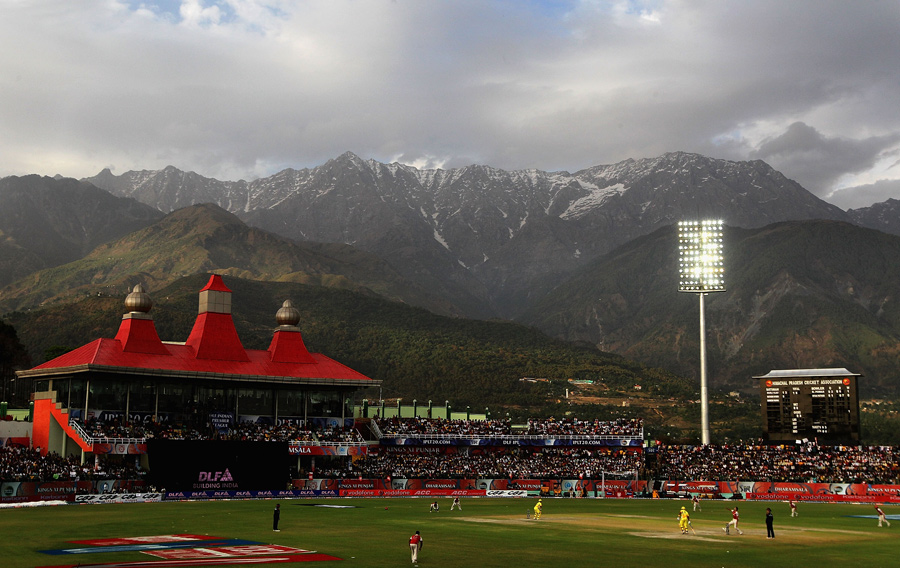
The action takes place at the astonishing Himachal Pradesh Cricket Association Stadium in Dharamsala, tucked in the unexpected spur of India that rises between the Stans to the west and the Himalayas to the east, with China’s swelling bulk beyond. If there’s a venue where cricket’s honoured dead gather to reopen old wounds, rewrite history and revisit that oldest of cricketing questions, ‘who really bowled fastest?’, Himachal Pradesh is surely it.

But enough of the scenery. While the scoreline may end up reasonably close, England haven’t truly turned up to this series since they stepped from the field at Rajkot, victorious by nine runs in the opening encounter. Indian wins by 127 runs, seven wickets and five wickets in the following three matches tell a one-sided story, which may have a significant impact on the futures of several England players.

In the minus column, Jade Dernbach and Craig Kieswetter have tested fans’ patience with a series of disappointing performances with ball and bat respectively.

The jury has been out on Dernbach for a while and, having been dropped from the ODI squad the forthcoming tour to New Zealand, he appears to have run out of chances for now.  It’s easy to see why England have persisted with him. His repertoire of slower balls, often expertly delivered, is balanced by genuine pace and he doesn’t seem phased by the big occasion. Returns of 4-45 against Pakistan and 3-44 against South Africa last year show what he’s capable of. But there have been many more hauls of no, one or two wickets, at a cost of 50, 60 or 70 runs, leading to an average of nearly 39 and an economy rate above six.

Dernbach also has the misfortune to be outlandishly tattooed, flashily earinged, absurdly haircutted and OSAO*. Remind you of anyone? While he’s baffling batsmen with slower balls conjured from behind his sleighting hand, or pinning them with a quicker one, this is all forgivable. But has no-one told him that with English fans, as soon as his performances dip, all of this will be weighed in evidence against him? He's clearly been spending too little time in the nets and too much in the cosmetic parlours and salons of south London, or gazing into the windows of Hatten Garden’s diamond merchants. Pack him back to Jo’burg where he belongs!

Living near the Oval I’ve seen a fair bit of Dernbach in his day job over the last few years, and I wish him well. I think he’s certainly got more to offer England, but there’s fierce competition for fast bowling places at present and for now he’ll have to wait for the likes of Hampshire and Durham to test his one-day skills, while others take the fight to New Zealand and Australia over the next twelve months.

Kieswetter, like Dernbach, has been dropped from the side for the back end of this tour, replaced by his Somerset teammate (and wicket-keeping understudy) Jos Buttler. Buttler is not OSAO, despite his name ringing alarm bells for the jingoists. It sounds unusual at first, but you could also imagine him the hero of a Thomas Hardy novel, even if he’s Jos the Obscure no longer.

Kieswetter is left out of the tour squad to New Zealand, with Buttler and Bairstow the hard-biffing keeper-batsmen in his place. As is de rigeur for Somerset batsmen, Kieswetter has an attitude to risk and reward that only has eyes for the latter. We are often told he is favoured by England for his six-hitting abilities, and then in the next breath that however good he may be at finding the boundary, he allows too many dot balls, too much pressure, in between times. So much for the clichés; more pertinently he just hasn’t been contributing.

Kieswetter’s absence gives me mixed feelings. I think Bairstow and Buttler will both be better bets in the short and long term, and Buttler’s extraordinary work as Somerset’s short-form ‘finisher’ will surely bear fruit at the highest level. But Kieswetter is an exciting cricketer and in possession of one of the most thrilling shots in modern cricket: the charging lofted drive over mid-on that ends with the batsman almost completely vertical, on tip-toe, with arms stretched above his head, bat raised high in salute to the ball as it soars to the boundary. The shot looks almost as good even when he’s stumped having missed it by a yard.

I am less optimistic about Kieswetter’s future chances with England than Dernbach’s. The irresistible rise of Joe Root this winter has secured one ODI batting spot already, with Jonathan Trott likely to take another on his return. While Buttler has yet to prove himself at this level, he’ll surely be given a run in the team and between him and Jonny Bairstow, there’s class and competition enough. Cook, Bell, Pietersen and Morgan should be kept out of the side only by injury and ‘rotation’ now, so it’s hard to see a way back. But England’s loss is Somerset’s gain, and I look forward to seeing him in action as the county season gets underway.

For now though, England have the result they want on the back of a century from Ian Bell, his second good score in the series bringing England’s second win.

Next time: a look at some of the winners from this tour, including Kent’s new skipper James Tredwell. Amongst other things, Tredders has been doing valuable work in keeping up the bald quotient in the side, which had been receding since the retirement of Andrew Strauss.

* Of South African origin

Sunday, 6 January 2013

Who are you calling chicken?


The Kentucky Fried Chicken Big Bash in Australia may sound like it does little to enhance cricket’s unathletic reputation, but like the other franchise tournaments that have sprung up around the globe in a headlong IPL-inspired gold-rush, it promises to deal only in the game’s most attention-seeking elements: big hitting, acrobatic catching, high-speed yorkers and low-speed bouncers. As with the IPL, part of the attraction for foreign audiences is seeing the mix of unknown domestic players with current international stars and retired greats.

This morning brought a Melbourne derby featuring Shane Warne, Luke Wright, David Hussey and Lasith Malinga for the ‘Stars’ and Marlon Samuels, Muttiah Muralitharan and Nottinghamshire and England’s Darren Pattinson for the ‘Renegades’.

I’m not a great fan of T20 for the usual curmudgeons’ reasons, but any cricket is better than no cricket, and it’s always a treat seeing the old warhorses out in combat. It’s not close to the real thing, and you could argue it tarnishes the memory of great Test competitors like Warne and Murali. But like hearing a voice you know in a crowd of strangers, it still brings a rush of comfort and familiarity, even if it disappears just as fast once you realise you were wrong all along: this isn’t Shane Warne of 708 Test wickets, the best captain Australia never had and England’s tormentor for more than a decade. This guy feels more like his off-field doppelganger, the generator of endless tabloid fodder, Tweeter to a million followers and a front man for online gambling and hair replacement. He doesn’t even look right, for Christ’s sake.

Warne is inevitably one of the biggest draws in the Big Bash. He is after all a proper celebrity, and look what he’s doing now – playing cricket! Warne captains the ‘Stars’ from his home-town, at least when he isn’t taking a break to spend Christmas in London with Liz Hurley. He’s also embraced the format’s innovations, including wearing an earpiece and microphone to chat to commentators, even while bowling. Memorably in last winter’s competition he talked viewers through his plans for the next ball – what batsman Brendan McCullum would try to do and how he would take the wicket – and then delivered exactly what he predicted, bowling McCullum with a faster, flat delivery as he shaped to sweep. This story went around the world, with Warne lauded for his apparent psychic powers. The bowler now seems doomed to endlessly try and repeat the trick without success, although he’s having fun with it, predicting ‘this one’s definitely gonna be caught and bowled’ or ‘hole out to midwicket’. Of course it’s genuinely fascinating to see the master at work, to hear his plans, see him adjusting his field and talking about why. Warne always said when he bowled his aim was to get the batsman playing a particular shot, rather than pitching the ball in a certain place. You can hear this now as he tells you ‘this guy’s gonna come down the pitch’ or ‘he’ll play forward and nick off to slip’. Warne can’t predict the result every ball, but he’s uncannily accurate in judging and controlling what the batsman will try to do.

 Today though the spectacle wasn’t so much the cricket as a sustained and unpleasant argument between Warne and the fiery West Indian batsman Marlon Samuels. During the Stars’ innings, Samuels tangled with David Hussey and appeared to hold his shirt to stop him setting off for a second run. After a brief confrontation the incident seemed to be done with, only for Warne to resurrect it when Samuels came in to bat at first drop in the Renegades’ innings. As viewers of West Indies’ tour in England last spring will remember, Samuels is not shy of confrontation, and is perfectly happy to use it to get his blood up for battle. On this occasion it got somewhat out of hand. First Warne approached Samuels talking about the shirt-pulling incident and repeatedly shouting ‘fuck you, mate’ until the broadcasters remembered to turn off his microphone. This didn’t stop them showing lots of replays of Warne mouthing ‘fuck you, mate’ while the commentators enthused about his passion for the contest.

Shortly after, Warne gently chucked a ball at Samuels in his follow-through, ostensibly passing it to the wicket keeper. Samuels responded with rather disproportionate force, flinging his bat down the pitch towards Warne. In truth it didn’t look at all like he was trying to hit Warne, but it was an extraordinary act in any event and caused a lengthy hiatus as the umpires tried to establish what happened and cool things down. It’s hard not to feel sorry for the domestic officials in these circumstances, who in the face of these superstars seem a little like Mr Muscle refereeing a heavyweight boxing match.

Eventually they resumed, and while it was an easy nine-wicket win for the Renegades, there was one final act in the drama involving Samuels. Lasith Malinga, the tournament’s leading wicket-taker, had bowled beautifully with extreme pace and control for no reward. There was nothing beautiful about the ball that ended Samuels’ stay at the crease: a brutal bouncer that took the top edge of the batsman’s attempted hook and smashed straight into the grill of his helmet. Samuels showed no obvious sign of pain, but clearly knew his match was over and walked straight off, blood dripping from his lips.